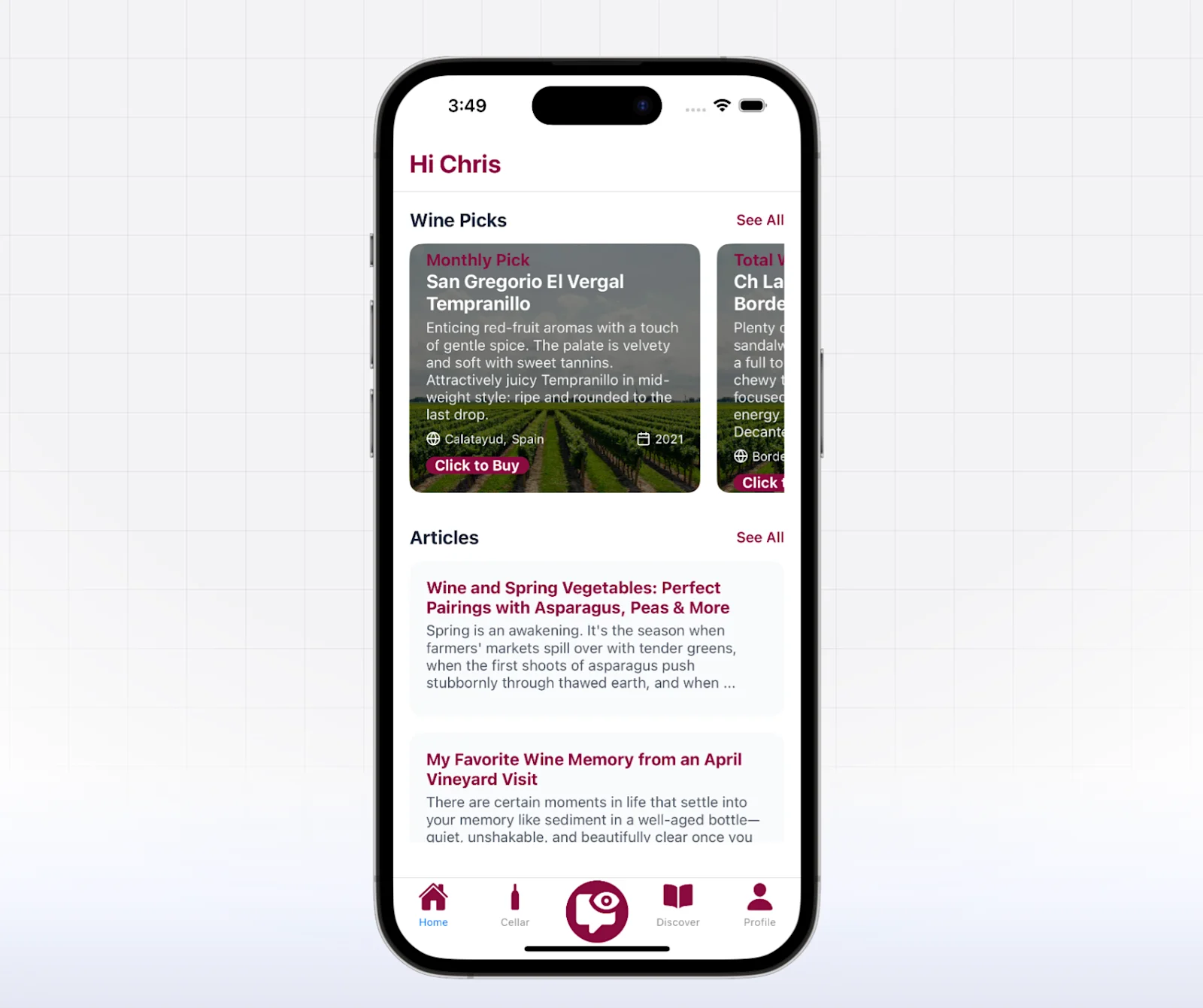
Cork Locker
Imagine having a personal sommelier in your pocket ready to demystify the world of wine whenever you need. Cork Locker provides a simple chat interface and makes use of advanced AI modeling and computer vision so users can upload a photo of wine list and get a recommendation or chat about their favorite vino.
Stack: Expo, React Native, AWS Amplify, Lambda, DynamoDB, OpenAI, Contentful
The Observation
At a dinner in 2022, I was asked to pick the wine. I know American wines well enough, but the restaurant was Italian and the list was entirely Italian. Before I could even start typing names into my phone, the waiter was back. That moment made something obvious: no tool existed that could meet you where you were.
When ChatGPT launched, I started solving it myself through prompting. When OpenAI introduced custom GPTs, I got closer -- but the GPT store wasn't out yet, access was limited, and none of the people I wanted to use this were going to pay for a ChatGPT subscription. By December 2023, the question had shifted from can I solve this for myself to how do I make this accessible.
The Problem
The dominant wine apps on the market are good at one thing: scanning a single bottle and returning a rating. Try to evaluate three wines from a list and the experience falls apart. More importantly, a rating isn't what you need when you're sitting at a table. You need someone to say get the 2020 Produttori del Barbaresco Ovello. Even today, the main competitors still aggregate what everyone else rated. That's a different product for a different moment.
The Solution
Cork Locker is an AI sommelier iOS app built around a simple premise: give people an answer, not a data set. Users can photograph a wine list or a shop shelf and receive a recommendation based on what's in the image, their personal taste history, and what they already have in their cellar. Because it's a chat interface, the conversation doesn't end with the first pick. You can push back, ask follow-up questions, plan a trip to wine country, or ask for a gift suggestion.
Building this in December 2023 meant working before structured outputs existed in the OpenAI API. Getting the vision and tool-calling pipeline right, knowing when to trigger a tool call versus answering directly, and structuring the incoming message so the model reliably processed what it was seeing was the hardest part of the build. Early on, the model would hallucinate answers or claim it couldn't see the image at all. Once I cracked it, I spent time in the developer community forums helping others work through the same issues.
On the architecture side, routing the AI layer through an API gateway was a deliberate call. Anyone coming from web development to iOS learns quickly that there is no quick release cycle, every update requires App Store approval. By keeping model logic and recommendation improvements on the backend, I can ship changes without a new app version. Adding shelf recognition after launch, for instance, required no update at all.
The app was built with Expo and React Native to keep a multi-platform path open without a full rewrite. I also built in content features, wine news, educational modules, and games specifically to give users a reason to open the app outside of a restaurant moment.
Where It Stands
Cork Locker shipped to the App Store in August 2025 after roughly eight months of friends and family testing. It is early, and the work now is on growth. The technical foundation is solid, the core experience works, and the architecture is built to improve without friction.