Hospice Ratings
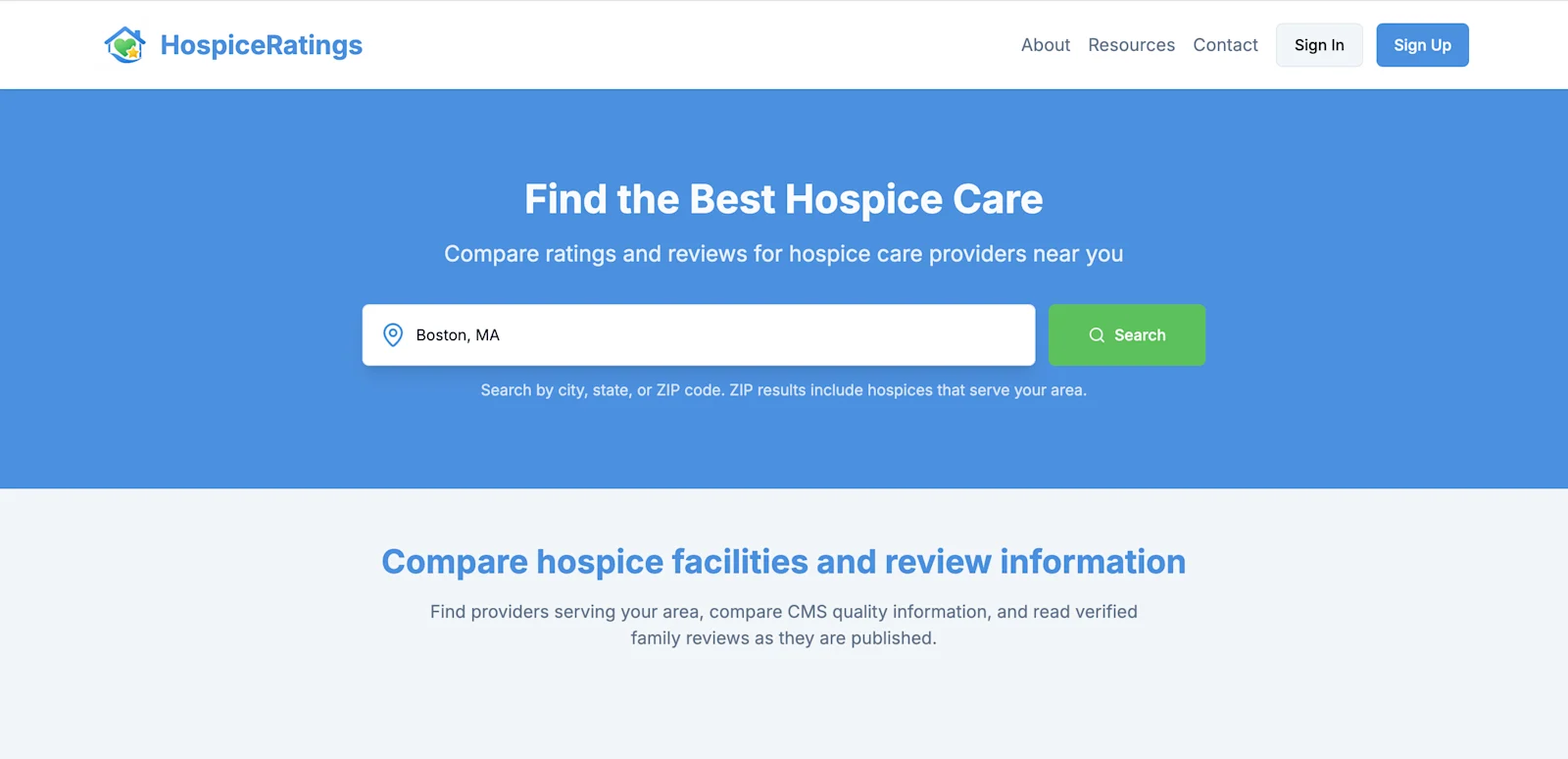
HospiceRatings.com helps families find and compare hospice providers, bringing Medicare data, family reviews, and provider information into one place.
Stack: Next.js, Supabase, Vercel, Tailwind CSS
The Observation
In 2018, shortly after finishing my coding bootcamp, I was in the hospital with someone close to me who was in the final months of a years-long cancer battle. Someone handed me a list of places to call about hospice care.
I visited one, but there was so much to understand and keep track of at a time when it was already difficult to absorb more information. Like many people who find themselves in that position, I kept coming back to the same thought: there has to be a better way.
I bought the domain HospiceRatings.com that year. The idea stayed with me, but it was only recently, after finishing a freelance project, that I returned to it. Development tools had advanced enough that a project I had set aside now felt practical to build on my own.
The Problem
A list of providers gives a family somewhere to start, but leaves them with the work of understanding their options. Which providers serve their area? What information can they compare? What have other families experienced?
Medicare publishes information about hospice providers, but having data available does not automatically make it useful to someone trying to make a difficult decision. Families still need a way to find relevant providers, understand the information, and keep track of what they learn.
That was the gap I wanted HospiceRatings.com to address: the distance between receiving a list of names and having enough context to decide whom to call.
The Solution
I built HospiceRatings.com solo using Next.js, Supabase, Vercel, and Tailwind CSS, with Medicare data providing the basic information for every provider. That gives the directory a foundation before providers join, while allowing profiles to become more detailed as providers come onto the platform.
Much of the product work involved deciding who should be allowed to do what. Families need a place to share their experiences, providers need a way to participate, and staff need the ability to address offensive content.
Users must create an account to leave a review, and staff can delete reviews that are offensive. I also limited user photo uploads to three, putting a concrete boundary around how much someone can attach.
Provider subscriptions offer different levels of access to richer profile information, provider photo uploads, and review responses. Providers can also pay for featured status. Payment does not affect their score.
These decisions required thinking through the relationships between the people using the platform. Building the pages was one part of the work; defining what each person could contribute and control was another.
Where It Stands
HospiceRatings.com is publicly launched, with basic provider profiles available and reviews, provider subscriptions, and review responses working. The next stage is onboarding providers so those profiles become more detailed and useful to families.
I am also using it myself. As I help my grandfather find hospice care, the tool I built to help other families is proving useful in my own search.